


ℹ️ Skip to key parts of the session by clicking on the chapter dots along the timeline.
Welcome to Card of the Month, where Charles Burdett (Author of Workshop Tactics) walks a group of Pip Club members through one or more of the Workshop Tactics cards. This time, it is when and how to use the Priority Map and Impact Effort Map tactics to ruthlessly prioritise. You’ll notice the video chapters (above) match up with the section headings of the write-up (below); if you’re short on time, read the highlights then watch the sections you’re most interested in!
Charles starts by explaining that these two cards perform a similar function - Priority Map is the 2x2 decision matrix that helps you prioritise a list of items. The axes can show impact vs effort (as in the second card we’ll explore), but could equally be used with different headings (risks vs knowledge, for example).
Priority Map tactic
The heart of the Priority Map exercise is that matrix, which filters items into categories based on two factors. Those categories are:
- Do now
- Plan to do later
- Defer/delete
But - as with most workshops - the value often comes from the conversations that your team will have while working their way through the process. Or, you can do this by yourself!
Charles’ advice is to bring a diverse range of people into the room so that you don’t end up with ‘group think’. He gives the examples of designers looking at which features to take forward into development, without including developers to explain how the build and implementation of those features might work.
Top tip: these workshops are only as good as the information you enter into them. Try Sailboat before doing a Priority Map workshop, to help you work out direction and obstacles (the obstacles can then be fed into this workshop).
This is a tool for ruthless prioritisation, which is crucial for teams and individuals alike. You can only really do one thing well at a time, so choose the thing that will get you the most bang (impact) for your buck (effort).
Priority Map in action
Charles and Ece (Community Host at Pip Decks) then put the tactic into practice with some actual Pip Decks items.
Side note: Assumption Map
There’s a third card - Assumption Map - that uses the risk vs knowledge 2x2 matrix. You enter assumptions into that matrix, such as ideas (we think this will be really popular). Pretty much any idea you have is an assumption if you haven’t yet got the evidence to prove it's right/workable. This tactic helps you prioritise which items to test so you can gather that evidence and de-risk your project.
Back to the Priority Map
Ece has added a load of ideas for Community and Events initiatives to explore with Charles. The items they discuss are:
- Creating event hosting guidelines
- Adding events to calendars
- Card of the Month sessions for new decks
- Launch Productivity Tactics deck
- Host Productivity Tactics events
- Launch a podcast
- Organise IRL local meet-ups
- Add event sessions based on time zones
So the first question is What are the competing priorities here? What’s going on those axes? In this case, it’s Impact vs Effort. This section is definitely worth watching if you are considering running this workshop for the first time.
There’s a mocked up image of where some of the items ended up on the matrix below. For accessibility, the text version of the list with the Impact vs Effort rating for each is just underneath. You’ll notice that this list differs slightly from the one that Ece started with; that’s a result of the conversations that Charles said would be so useful.
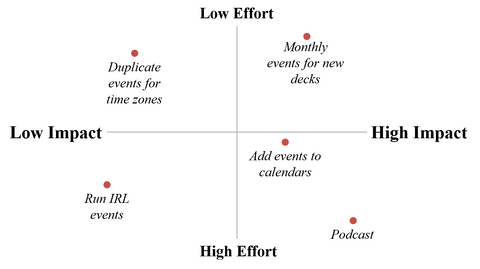
- Creating event hosting guidelines: LOW effort; HIGH impact (it feels like low impact, until it’s needed… ).
- Adding events to calendars: HIGH impact, MEDIUM effort.
- Card of the Month sessions for new decks: HIGH impact; LOW effort.
- Launch Productivity Tactics deck: HIGH impact; HIGH effort.
- Beta/focus groups and cohorts for Productivity Tactics: HIGHish impact; HIGHish effort.
- Host Productivity Tactics events: MEDIUM impact; MEDIUM effort.
- Launch a podcast: HIGH effort; HIGH impact.
- Organise IRL local meet-ups: HIGH effort; LOW impact.
- Duplicate events for different time zones: LOWish effort; LOWish impact.
What next?
If you have too many items in the Low Effort, High Impact quadrant, you can create a single axis (either impact OR effort - whichever is your priority) and place each item somewhere along that line. You’ll end up with a list of things to do and the order in which you should do them!
Whether you need to do that last little exercise or not, you’ll want to follow this whole exercise up with something like Who, What, When so that you can be sure the necessary actions are allocated and followed through on. When you put names and dates down it seems to ensure people get things done!
You could also use Sticky Steps to break down the pathway towards any items in the High Effort, High Impact items that you’ve deferred until later. It helps you work backwards from a desired end result to the very beginning, leaving you with a list of steps to take along the way.



One of the few newsletters I look forward to.
- Dave Cunningham, Head of DesignOps @ NHS
